
Post-natal exercise
- Oct 23, 2014
- 10 min read

Returning to exercise after childbirth is important and despite the tiredness, can be extremely rewarding, both physically and mentally. It allows quality time to yourself, improving mood and energy levels as well as helping to get rid of pregnancy weight gain and to regain muscle strength. It is important to remember you cannot just jump straight back into your pre-pregnancy exercise regime and there are a few important things to consider which are discussed below.
It is NORMAL to have a ‘saggy’ looking stretched tummy for the first few weeks and even months after giving birth, do not expect it to suddenly snap back into shape and do not put extra pressure on yourself by setting unrealistic goals, enjoy being a mum too!
Effects of relaxin on the body
During pregnancy your body produces a hormone called relaxin which causes ligaments to become more elastic, allowing the pelvis to accommodate the growing baby and to help the pelvic floor & abdominal muscles stretch during birth. Although relaxin is no longer produced after birth, the effects of relaxin on the ligaments and joints may persist into the post natal period. The exact length of time the effects persist is unknown and appears to vary but is thought to be around 4-6 months. This may cause joint pain during high impact exercise, especially in the knees, hips and back and care should be taken not to over stretch. Your oestrogen levels also decrease after child birth and when breastfeeding. Oestrogen has a protective effect on joints and bones so during times of decreased oestrogen, such as when breastfeeding or during the menopause, women may experience joint pain, especially in the hips and knees when exercising, particularly during high impact sports like running. These hormonal changes appear to effect some women more than others and do NOT necessarily mean high impact activities like running should be avoided in the first 6 months after birth, however appropriate strength work to build up muscle strength to help support the joints should occur and if knee/hip pain is experienced then other lower impact activities may need to be considered.
Abdominal muscles during pregnancy
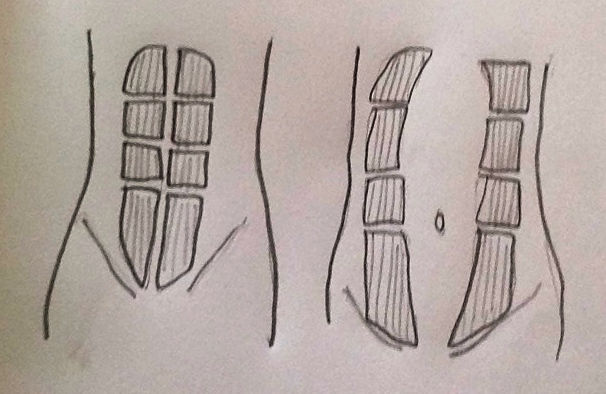
The rectus abdominis muscles (‘6 pack’) which run in two parallel lines up your tummy, stretch and lengthen during pregnancy. Rectus abdominis separation occurs when the two bands of muscle which used to lie parallel before pregnancy stretch away form the midline to make more space for the growing uterus, see below photo. This separation is known as diastasis recti and is normal in pregnancy. In the post natal period we want to encourage the ‘gap’ to reduce and the muscles to shorten and strengthen again in order to regain full function of the abdominal muscles and a flat tummy. Crunches and planks can make the separation worse so AVOID them in the initial post-natal period, at least until the gap has reduced to 1-2cm. Crunches are NOT required for either a flat stomach or good abdominal muscle strength. Three- four days after birth your muscles will begin to realign and the wide separation will reduce. In most cases by 8 weeks the gap has reduced to 2cm or less. Gentle exercises like pelvic tilts can begin immediately after birth and will help to reduce the abdominal separation. See below. Check your post-natal pack for an NHS leaflet with exercises to do. You can check your own degree of separation by doing a 'rec check'.
Breastfeeding & exercise
If you are breastfeeding then ensure you have an adequately supportive and well fitting sports bra.
For comfort, feed from both sides before exercise, especially if you are doing vigorous or high impact exercise. Moderate exercise does NOT affect milk production, nutrient composition or babies weight gain. Ensure you are adequately hydrated by drinking plenty of water and ensure your diet contains adequate protein. Oats have anecdotally been thought to increase milk supply although there is no scientific evidence to support this. An exclusively breast feeding women requires about 200-300 extra calories/day. Use common sense, drink when thirsty, eat when hungry and ensure a balanced diet. Lactic acid may be present in breast milk when mums are exercising to the point of exhaustion (ie 100% intensity). There are no known harmful effects of lactic acid in milk but if your baby seems reluctant to feed after a particularly high intensity session then this may be something to consider, although showering to remove salty tasting sweat is also likely help.
Rest & sleep!
Rest is important too, try and sleep or rest when the baby does. It is normal to feel more tired than you ever thought possible and exercise can help improve mood and boost energy levels but don’t over do it and allow at least 2 rest days a week to let your body recover. If you feel exhausted or have been up or night then do not feel guilty about allowing yourself a rest instead of exercising
where to start…
It is important to consult your midwife or GP if you have any questions and to never attempt anything that causes pain. Vigorous exercise should be avoided until bleeding has stopped and you have had a 6-8 week post-natal check by midwife or doctor. The time scales are to be used as a guide only, some people may need longer recovery time than others. You should stop if discomfort or pain is experienced.
stage 1 (immediately after birth)
Pelvic floor exercises
More detailed information on pelvic floor exercises can be found here. Pelvic floor exercises can be started immediately after birth. They are an important part of post-natal recovery as many women experience stress incontinence after having children. A good structured approach to pelvic floor exercises is important to reduce the likelihood of problems. Do both the fast and a slow exercises at least 3 x a day. Think ‘squeeze & lift’ on the contraction and then allow them to fully relax. Pelvic floor dysfunction is NOT normal after pregnancy and there are things that can be done. Perform the pelvic floor exercises at least 3 x /day as above and visit your GP if problems persist. As discussed below, strengthening of all the muscles around the hips, glutes and adductors etc will also help with pelvic floor function and control.
‘Core’ exercises
The term ‘core’ is hard to define but it should not just mean your abdominal muscles, it should include muscles of your hip, back and abdominal muscles and refers to the ability to maintain lumbopelvic stability.
pelvic tilts (2-3 sets of 10-15 reps) and deep breathing exercises (performed lying on back x 10 reps) can be started immediately after birth. Do not underestimate the importance of deep breathing to help remind yourself how to ‘use’ the deep abdominal muscles again. The key points are that it should be slow and controlled, breathing out as you flatten/tightened your tummy keeping your spine in a neutral position. Also when walking and sitting, consider correct posture, standing up straight and tall, shoulders back and relaxed, pelvis in a neutral position without excessive curvature of the lower spine. Correct pelvic position is important as many women develop an exaggerated pelvic tilt during and after pregnancy due to the postural and muscle imbalances associated with the increased weight of the uterus. This includes shortened and tight hip flexors and an exaggerated curvature of the lumbar spine (lordosis) combined with weak/ stretched / unused abdominal muscles.More information on pelvic position can be found here.
Cardiovascular exercise
Depending on the type of delivery you had and how much discomfort you are experiencing, gentle walking can commence in the first week or so after birth. Start relatively slowly and gently. Once you feel able, start short, gentle walks for 10-15 minutes every day although don’t do anything too strenuous until the lochia has stopped and stop if you experience discomfort. In the early days more than 10-15 minutes walking may make you feel quite uncomfortable and ‘heavy’ in the pelvic floor area so take it steady!
Stage 2 (at least 7-14 days after birth)
'Core' exercises
Continue deep breathing exercises, avoiding arching your back or using your back or bottom muscles to facilitate the tightening of the tummy, as with pelvic floor exercises, check you are not clenching your buttocks! Try starting to time the exhalation and flattening of the tummy with drawing up and squeezing the pelvic floor. You can progress to deadbug regressions using just the legs initially, extending alternate legs gently and slowly straight out close to the ground without letting your back arch off the floor and toe touches (similar to the deadbug leg extensions but touching alternate toes slowly down to the ground without letting back arch off mat. Movements should be slow and controlled work on timing deep abdominal movement with breathing, breathe in let tummy expand out, slowly exhale, draw tummy flat to spine. Start by performing only 8-10 reps 2-3 times and build up as you gain strength.
Pelvic floor exercises
Continue as before.
Cardiovascular exercises
As the swelling and bruising starts to reduce, the uterus contracts back down, and lochia reduces, the walking can become increasingly brisk and you can push the buggy for longer periods of time harder and faster. start thinking about good posture and using your tummy muscles. Ensure the buggy handle is appropriate height so you are not stooping or bending forwards. Beginning too vigerous exercise too early may cause bleeding to start again or become heavier so take it slowly and steady to start.
Stage 3 (6-8 weeks after birth, 12 weeks if c-section)
After your post natal check, as long as you feel ok and your GP/midwife has given the go ahead you can start thinking about returning to your old activities/classes. If you are attending a fitness class or bootcamp ensure to inform the fitness instructor that you are post-natal, take it easy and gradually build up to joining in with everything. Avoid sit-ups/crunches in the first few months after giving birth. By 8-weeks the normal midline rectus abdominis separation that occurs during pregnancy has normally reduced to 2 cm or less especially if the correct exercises are performed after birth. Contact your midwife if the gap is >2 cm after 8 weeks and do not return to old activities or do crunches or planks.
Strength training
Start gently with bodyweight exercises and build up gradually. Gym based work such as squats and lunges are fine to start again however, unless you have been weight training throughout pregnancy start with bodyweight exercises before adding weights, ensuring correct form and technique. Stop if you experience pain. Continue to work hard on ‘core’ strength continuing with exercises like deadbug regressions & deep breathing, progress to performing the deep breathing on all 4’s as long as midline separation is <2cm. Consider starting to add in more challenging exercises like planks only when your midline separation is not >2cm. if you experience midline abdominal bulging or ‘doming’ then stop prone exercises and exercises on all fours like the plank and seek medical advice. Standard pelvic floor exercises can be continued although with a large amount of post-natal women experiencing stress incontinence they are unlikely to be adequate on their own, adding in exercises like squats also help strengthen the pelvic floor and strengthen the gluteals too. A wall squat using a swiss ball helps with balance and stability if a free standing squat is difficult. Many post natal women have relatively weak glutes and tight hip flexors as a result of postural changes during pregnancy so I would advise working on exercises to strengthen the glutes and stretch the hip flexors. Strengthening the adductors is also likely to be beneficial Glute & hip muscle strengthening exercises There are dozens of exercises which can be done to strengthen and ‘activate’ all the muscles around the hips including the glutes (glute max, med and minimus), hip flexors and adductors, care should be taken to ensure proper form and that you are working the correct muscles, ie the bum! Strengthening the glutes is also thought to help strengthen the pelvic floor muscles. Compound exercises like squats and lunges are useful but I would also suggest some more glute specific exercises like glute bridges with resisted knee abduction, side step crab walking and single leg glute bridges etc. Resistance bands are very useful for this.
Glute strengthening exercises
There are dozens of exercises which can be done to strengthen and ‘activate’ the glutes and in fact all the muscles around the hips including the glutes (glute max, med and minimus), hip flexors and adductors, care should be taken to ensure proper form and that you are working the correct muscles, ie the bum! Strengthening the glutes is also thought to help strengthen the pelvic floor muscles. Compound exercises like squats and lunges are useful but I would also suggest some more glute specific exercises like glute bridges with resisted knee abduction, side step crab walking, single leg glute bridges etc.
Cardiovascular exercise
If you decide to start running then start slowly and build up gradually. Initially, try a very short gentle run involving a maximum of only 5-10 minutes of running. Consider a walk:run programme such as the NHS couch to 5K. Run specific strength work is also likely to be beneficial to help minimise the risk of injury especially in those first few months after birth when glutes tend to be weak and hip flexors tight. For runners, the free Kinetic Revolution 30 day challenge is a great way to improve run specific strength, and although designed for runners would benefit hip strength & flexibility for those of you who prefer gym based strength work too. When running and doing other exercise remember to be aware of using your abdominal muscles and some deep breathing before a run to be aware of tightening your tummy is a good idea. If running is too high impact for your joints then consider lower impact options like pilates which will greatly improve overall strength and flexibility or even spinning for cardiovascular fitness. High intensity interval training (HIIT) is great for fat burning but build up gradually.
Key points
Don’t expect to be able to rush straight back into your pre-pregnancy exercise regime
Gentle exercises can be commenced at home immediately.
Wait until you have had a 6-8 week postnatal check-up before commencing more vigorous exercise.
If you had a c-section it is advisable to wait 12 weeks before commencing vigerous exercise.
Wear a good supporting bra to protect the breasts when exercising.
If you are breastfeeding, feed before exercising from both sides.
Drink plenty of fluids.
Don't perform vigorous exercise when hungry.
Incorporate exercise into your daily activities as much as possible.
listen to your body and rest if you are feeling especially tired..
Stop immediately if pain is experienced or make adaptations if you feel uncomfortable. Don’t rush.
Gentle exercises can begin immediately.
Abdominal crucnhes/ sit-ups are NOT necessary and are NOT advised.
Glute strengthening exercises and squats are important to help pelvic floor function.
Ensure you are working the correct areas, check you are feeling it in the appropriate muscles & may attention to technique. The key is in the detail!
video links of exercises:
Deep breathing: https://www.youtube.com/watch?v=xPSryfVdC4M&list=UUWZtnkBwXZRUB_MiMvUu_wg&spfreload=10
Deadbugs & regressions
https://www.youtube.com/watch?v=rbemelnkHag
Pelvic tilts
https://www.youtube.com/watch?v=sXv4jtvkGHo&index=14&list=UUWZtnkBwXZRUB_MiMvUu_wg&spfreload=10
Glute bridge raises with resisted knee abduction
https://www.youtube.com/watch?v=ikQ3O447OHQ&index=8&list=UUWZtnkBwXZRUB_MiMvUu_wg
Hip flexor stretches
http://www.kinetic-revolution.com/hip-flexor-stretching-dont-just-go-through-the-motions/
Contact me for more advice or for more information on one-one post natal personal training.


Comments